 VKS Network Services
This section describes the procedures for deploying the Supervisor within a vSphere environment.
Different network options for Supervisor deployment
Explore the specific network architectures available for your Supervisor cluster:
Architecture |
Description & Use Case |
|---|---|
| 1. VDS + FLB | 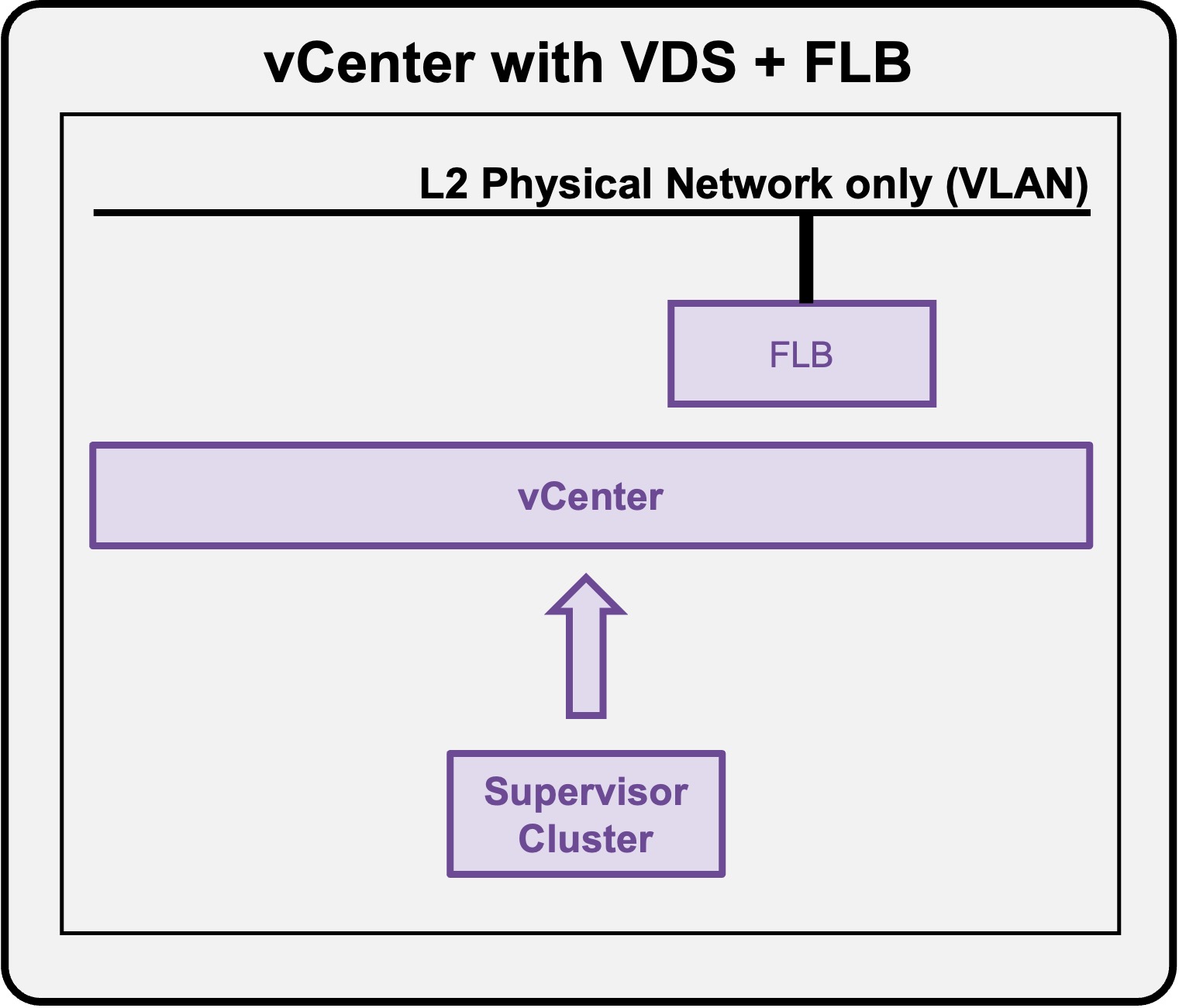
|
| 2. NSX + DTGW or NSX + CTGW |
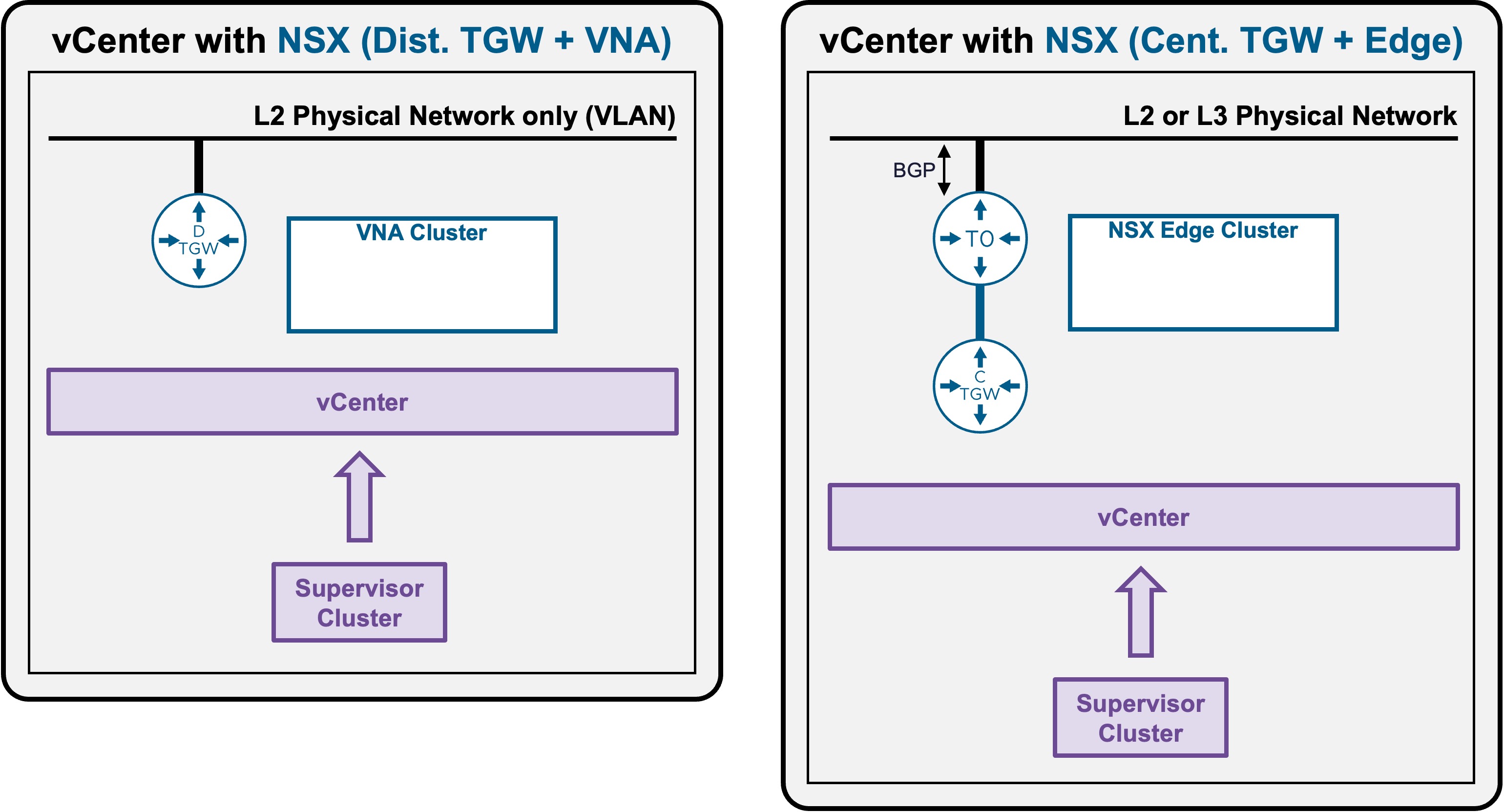
|
Detailed Architecture Pros & Cons
1. Supervisor with "VDS + FLB"
- Pros:
- Footprint: Slightly smaller overall footprint (the FLB appliance is slightly smaller than a VNA)
- VMware Editions: Available in VMware vSphere Foundation (VVF) and VMware Cloud Foundation (VCF)
- Cons:
- Network Services Limitations: Lacks full support of Network Services such as Subnets, Static Routes, NAT
- VCF Integration Limitations: Lacks full support for other VCF components, specifically VCF Automation (VCF-A)
- Scale: All VIPs are managed by a single FLB's Active/Standby (A/S)
- Requirements:
- L2 Connectivity: L2/VLAN connectivity required across vCenter cluster(s)
2. Supervisor with "NSX + DTGW" or "NSX + CTGW"
- Pros:
- Security:
- No possible external access directly to K8s Nodes
- Option to control application communication including:
- Cross-Container via Antrea CNI (DFW)
- Cross-VPC VIP communication (VPC Connectivity Policies)
- Scale:
- Uses fewer public IPs (K8s nodes use private IPs)
- VIPs are highly scalable, distributed across up to 10 VNA or Edge Nodes in an Active/Active (A/A) configuration
- Security:
- Cons:
- VMware Editions: Only available in VMware Cloud Foundation (VCF) (not VMware vSphere Foundation (VVF))
- Operations: Requires NSX (though installation and management remain very simple)
- Footprint: Slightly larger footprint (the VNA or Edge Node is slightly larger than the FLB)
- Requirements:
- For both DTGW/CTGW: Large MTU (min 1700 - recommended 9000)
- For DTGW: L2/VLAN connectivity required across vCenter cluster(s)
- For CTGW: Physical network with BGP routing protocol
Upcoming Architectures
The following architectures will be covered in future updates:
- Avi Load Balancer
Document Versioning
This guide is updated for VCF 9.1+.
If you are running an older version, some options may not be available.